relationships

No! All of Me: Therapists Reflect on Identity, Perfection, and Being Seen in K-Pop Demon Hunters

We’ve been talking a lot lately at People Bloom about K-Pop Demon Hunters. Honestly? We’ve lost count of how many times we’ve all watched it.

In a bit of a departure from our usual style, several of our clinicians are sharing their reflections here. Before we dive in, a quick note: none of us identify as belonging to Korean culture. We have, however, worked with many clients with Korean roots and wanted to approach this story thoughtfully. To add more depth, we recommend these videos from a Korean teacher, which offer beautiful cultural nuances about the film.

This movie hit us differently. While it’s packed with style and supernatural stakes, what lingered for us as clinicians was the raw, human pulse underneath the spectacle. At its core is the desperate desire to be truly seen and accepted, even when the world demands we hide. That tension between protecting ourselves and being fully known is a struggle we see in our practice every day.

Ketaki on Being Seen and Heard

The Longing to Be Seen and Heard

One of the things that stood out to me in K-Pop Demon Hunters comes from the lyrics of What It Sounds Like. The song captures a longing many people have for spaces where they’re truly seen and heard. That idea shows up powerfully in Rumi’s story. When her demon side is revealed, people’s perception of her changes instantly. Yet she hasn’t actually changed. She’s always been part demon and part human. What shifts is how others see her.

“No! All of Me!”

That shift in perception is especially painful in her relationship with Celine. In many ways, Celine did the best she could with what she knew. At some point, though, it stopped working because there were other layers that hadn’t been acknowledged. Their confrontation captures this heartbreak in such a simple but powerful exchange: “Why can’t you love me?” “I do love you.” “No! All of me!” Underneath that dialogue is a longing many people carry.

We want to know that someone can see all of us and still stay.

You Are Not Broken

Watching that moment, I kept wishing for a message that so many people need to hear: You’re not broken, and you don’t need fixing. At the same time, the story also shows how easy it is to fall into the trap of ruminating and letting guilt run your life. When guilt becomes the loudest voice, it can convince you that this is who you are and what you’re allowed to become.

But it doesn’t end there.

Choosing Hope

What I appreciate about the film is that it offers another possibility. It’s a powerful shift to see yourself as you truly are, and who you are doesn’t have to define what you do next. You still have a choice. One scene in the film captures this beautifully. When the street vendor gave Rumi a free bracelet and called Jinu “hopeless,” Rumi said to him, “That’s the funny thing about hope. No one else gets to decide if you feel it. That choice belongs to you.” In this case, hope doesn’t necessarily arrive when everything’s resolved. Sometimes it shows up right in the middle of the mess.

Acceptance in Everyday Moments

The film also shows acceptance in quieter ways. There are moments of appreciating food without shame, and moments where rest looks like lying on a couch instead of constantly pushing forward. These scenes remind us that being human includes allowing ourselves space to pause and simply be.

Nuanced Support

We also see how support from others can be complex and imperfect. When HUNTR/X arrived too late to save the passengers on the train, Zoey said to Rumi, “I’ll always be on your side, but it’s really hard to understand this time.” Support doesn’t always mean complete understanding. Sometimes it means someone staying beside you while you try.

The Possibility of Becoming More

While this isn’t an actual dialogue between Rumi and Jinu, I can imagine them saying something like this to each other: “I didn’t think I could be different.” “You could be more. You don’t have to be this way.” This sentiment captures something important. Being accepted for who you are doesn’t mean you’re stuck there. When we allow ourselves to be fully seen, both human and demon, strength and vulnerability, the possibility for something new emerges.

And that’s a beautiful thing.

Sunny on Perfectionism, Safety, and Intergenerational Trauma

When Perfection Is About Safety, Not Success

(What K-Pop Demon Hunters Reveals About Trauma, Identity, and the Pressure to Perform)

We often think of perfectionism as ambition. Drive. Discipline. High standards. From the outside, it can look impressive and responsible.

But for many people, especially those raised with cultural pressure, generational sacrifice narratives, or high expectations, perfectionism isn’t really about success.

It’s about safety.

In K-Pop Demon Hunters, the idols live double lives. On stage, they are polished and flawless. Off stage, they are battling demons and hiding parts of themselves they fear others cannot see. Rumi’s struggle is especially powerful. She is both human and demon, but she believes that if her full identity is exposed, everything will fall apart. Authority figures reinforce the message: if people see the whole truth, it will “ruin everything.” Sacrifice is invoked. Reputation must be protected. Image becomes survival.

The message underneath it all is clear:

If you are perfect, you are safe.
If you are fully seen, you are a threat.

For many people, that message did not come from a fantasy world. It came from childhood.

If you grew up hearing things like, “We sacrificed so much for you,” “Don’t embarrass the family,” or “You have to work twice as hard,” your nervous system may have learned something very specific: if I do everything right, nothing falls apart. If I succeed, I belong. If I don’t make mistakes, I won’t be rejected.

Perfection becomes a protective identity. A high-functioning shield. A way to survive.

You may tell yourself, “If I can just pass this hurdle, then I can rest. If I can perfect this, then I’ll finally get what I want.” But the finish line keeps moving. There is always another stage. Another expectation. Another invisible demon to fight.

For people navigating multiple cultures, this pressure can intensify. You may carry a public identity and a private one. At work, you are composed and polished. At home, you navigate tradition and generational expectations. In social spaces, you adjust again. The emotional labor of code-switching, balancing how you present with how you actually feel, is exhausting.

You may constantly cater to one side of yourself, trying to fit into a rigid mold. In the film, the Golden Honmoon represents this kind of perfection: flawless, pure, controlled. But it is also rigid. Unforgiving. There is no room for cracks.

By the end of the movie, that gold barrier is replaced by a rainbow-colored one. Not perfect. Not singular. Many colors at once. It symbolizes growth and the acceptance of imperfection. It shows that protection does not have to mean rigidity.

This shift mirrors what healing often requires.

Perfectionism frequently develops in response to trauma, not always dramatic trauma, but relational trauma. Conditional love. High criticism. Family instability. Discrimination. The pressure of representing your community well. Sometimes shame, fear, and guilt are passed down unintentionally. Caregivers who survived hardship project their anxiety forward. “For the greater good” becomes the justification. Achievement becomes repayment.

And so you become the strong one. The reliable one. The achiever. Like Mira, you carry your dual life quietly. Like Zoey, traits that once got labeled as “too much” get repurposed into something productive. You survive by adapting.

But inside, there may be shame. Fear. Guilt. A constant sense that if you crumble, the people who depend on you will see your cracks, and everything will collapse.

Perfectionism says: protect yourself. Hide the demon. Don’t let anyone see.

Healing says something different.

In K-Pop Demon Hunters, the characters are strongest when they stop hiding and fight together. They learn they don’t have to trap their guilt alone. There’s even a small, playful moment, “Couch, couch, couch!”, that reminds us how foreign rest can feel when you’re used to always being “on.” For many high achievers, rest feels unsafe. It feels undeserved. It feels like letting down the system.

But being human includes silliness. Softness. Pauses.

Rumi’s struggle with being both human and demon reflects something deeply relatable. Many people feel split, between strength and vulnerability, tradition and individuality, ambition and exhaustion. The pressure to choose one identity over the other creates internal conflict.

But healing is not about choosing.

It’s about integration.

You can be ambitious and imperfect.
You can honor your family and set boundaries.
You can represent your culture and still be fully human.
You can be high-functioning and still need support.

Perfection paints life in gold, rigid and controlled. Integration allows the full rainbow.

If perfectionism has shaped your life, it may help to ask: When did this become necessary? What was it protecting me from? Who was I trying to keep safe?

Perfection likely helped you survive something. It kept you stable. Accepted. Needed.

But survival strategies don’t have to define your entire identity.

You are allowed to step off the stage sometimes.

You are allowed to be seen whole, not just polished.

You are allowed to rest without earning it.

You are allowed to hold multiple colors at once.

Perfection was about safety.

But worth has never required it.

Amy on Identity, Redemption, and Trust

The Pressure to Stay in Your Role

A theme that stood out to me in K-Pop Demon Hunters is the pressure each character feels to stay in a certain role. Rumi carries the weight of leadership. As the leader, there’s an expectation that she keeps up a certain image and stays strong for everyone else. That pressure leaves very little room for her own internal struggle. She’s expected to hold everything together.

At the same time, Zoe and Mira also want to be seen. They each have their own characteristics, personalities, and perspectives that they bring to the group. Yet the group dynamic sometimes limits how much they can step into those parts of themselves. When one person carries the leadership role, it can unintentionally shape how everyone else shows up as well.

Wanting to Be Seen for Who You Are

This tension between roles and identity appears throughout the film. Several characters feel pressure to present themselves in a certain way, even when their internal experience is far more complicated. Jinu’s story highlights this struggle in a particularly powerful way. He’s expected to act and show up in ways that hide his humanity, while internally he carries regret and a longing for something different.

Redemption and the Courage to Change

Jinu’s storyline also brings up the theme of redemption. We all have moments we regret. We make mistakes and sometimes carry those moments with us for a long time.

The question becomes how we face those mistakes. One path is rumination, where regret keeps repeating itself and begins to define how we see ourselves. Another path is acknowledging what happened and letting it become a learning experience.

Even though the path isn’t linear, Jinu moves toward that second path. In the end, he faces what he’s done and chooses differently. Instead of letting his past define him, he breaks free from it.

In that moment, he’s able to forgive himself.

The Risk of Trusting Someone

Another powerful part of this story is the trust that develops when someone takes a risk with another person. Trust often begins with vulnerability. It means letting someone see parts of us that we usually keep hidden.

When that risk is met with understanding or compassion, something shifts. A person begins to believe that change might actually be possible.

For me, this is one of the most meaningful aspects of the story. Growth rarely happens in isolation. It often starts when someone takes the risk to be vulnerable, and another person responds with trust.

If that isn’t healing, I don’t know what is.

Ada on Understanding Old Patterns and Healing

Carrying Patterns Across Generations

In K-Pop Demon Hunters, we see how patterns of behavior and belief can carry across generations. The way Celine teaches Rumi to hide the demon part of herself is about survival. It’s a way to preserve tradition and protect her from a world that might not accept her fully. That’s understandable. Stepping outside what we know and breaking from the familiar is always scary, even when the tradition is no longer sustainable.

Hiding Parts of Ourselves

Jinu faces a similar challenge. He has good reasons to hide parts of his truth because if he shared what really happened, he’d experience even more shame and rejection. Nobody wants more of what they’re already fighting against. Both Rumi and Jinu show how people often carry the weight of survival strategies long before they understand their impact. These choices may have made sense at the time, yet they can limit connection and healing if they go unexamined.

It’s Okay to Not Know

I often say that if we’ve never been shown how to do something, we’re not supposed to know how to do it well. It’s okay to not know, and to experience the ups and downs of figuring it out with a trusted other. Connections can be healing. I’m glad Jinu had Rumi, and Rumi had Zoey and Mira. It makes me really grateful for the support our clients have outside the therapy room.

It Does Not Change How We See You

While Golden was the song that made it big, for me, What It Sounds Like will always be my favorite. It’s hard to go through life unscathed. Whatever patterns or habits we try to hide, whatever broken pieces we try to put back together, whatever distance we put between ourselves and others so we won’t be discovered… What if we could be seen for all of who we are and still be accepted and loved? Wouldn’t our jagged edges reflect a myriad of light if we could shine together?

Our clients are brave to share parts of themselves they don’t often feel comfortable showing the world. When we see their humanity, we want to tell them: "Thank you for sharing with me. It doesn’t change how I see you one bit.”

What would it be like to really take that in?

Let’s See, Support, and Celebrate You

At People Bloom, we want to see you, support you, and celebrate you exactly as you are. And, if you’ve already nailed self-acceptance but the ruminating voices in your head won’t quit, or if you’re stuck in a pattern that’s holding you back, we’re here for that too.



Ketaki Tongaonkar is a Licensed Mental Health Counselor at People Bloom Counseling. She helps people navigating multiple cultures and identities build lives that feel more authentic and balanced. She also works with stressed-out overachievers to develop healthier relationships at work, at home, and in their communities.

Originally from India, Ketaki grew up surrounded by strong community and cultural traditions. She understands firsthand the tension that can come from honoring where you come from while also becoming your own person, and she hopes she can help you get there too.


Sunny Patel is a certified EMDR and trauma therapist at People Bloom Counseling. He believes that your past doesn’t have to define your future. He helps individuals, couples, and families "deconstruct" trauma and quiet the self-doubt that often follows difficult life transitions. As a first-generation South Asian American, Sunny is particularly passionate about helping people navigate cultural expectations and find their own unique voice.

A huge fan of superhero movies, Sunny sees the 'superpower' potential in everyone. However, he wishes films showed more of the boring recovery time, because he knows that in real life, the most heroic work happens during the slow, gritty, and often zigzagging path of healing.


Amy Lai is a Licensed Mental Health Counselor at People Bloom Counseling who is passionate about helping people grow through life’s most difficult transitions. Drawing from her own experience as an immigrant and a caregiver, she supports adults navigating cultural identity, boundary setting, and the unique challenges of the "sandwich generation." She also finds it incredibly rewarding to walk with those navigating medical conditions or caregiver burnout.

Given how eventful life can be, she often takes things with a grain of salt. However, there are no conversations too small for the therapy room. If it matters to you, it matters to her, and she is committed to helping you feel seen and heard.


Ada Pang is the proud owner of People Bloom Counseling, a psychotherapy practice in Redmond. She helps unhappy couples find safety and connection in their relationships. She also works with cancer thrivers and their caregivers as they integrate cancer into their life stories.

The only thing she’d change about the movie is the last scene where HUNTR/X give up their couch time to be with fans. After everything they’ve been through, she hopes they’d find more couch time before the sequel.

When Apologizing Becomes a Burden: How to Strike a Balance

Recently we hosted a friend and her family from college. Their family of three were traveling from the east coast. It was my first time meeting their kid, and I was looking forward to our late night conversations. Seattle weather was surprisingly cooperative for the few days they were here. 

They were wonderful and very considerate guests. In fact, a little too considerate and apologetic. 

The apology overload

You see, as with a young child, spills happen. They cleaned up quickly and there were no permanent damages, but the parents were very apologetic. Then came more apologies: They were staying out later and will be missing dinner. They were sorry for making noise in the early morning. They apologized for taking up space in our home.

At first, the constant apologies seemed polite. But soon, it became apparent that their frequent apologies were creating a subtle, but significant shift in our interactions.

As a therapist, I've often noticed how apologizing can sometimes be more than just a polite gesture. It's a complex social behavior that can, at times, place an unintended burden on the person being apologized to. When someone frequently apologizes, it often puts the onus on the other person to respond with reassurance, which can create an imbalance in the relationship.

In the case of my friend's visit, their continuous apologies began to make us feel uncomfortable. Instead of enjoying our time together, I felt compelled to constantly reassure them that everything was okay. What started as a relaxing visit evolved into something that required emotional labor on our part. 

Reflecting on the experience

One evening, after yet another apology about their child being too rowdy, I felt drained. I didn't have the energy to address the issue at that moment, so I kept quiet. It wasn't until after they had left that I reflected on the situation. This experience highlighted how continuous apologizing, even when well-intentioned, can sometimes have unintended consequences.

I found myself repeatedly saying, “Oh, it’s not a problem…” “It really wasn’t a big deal…” “No worries…” “It’s okay…” Over time, offering constant reassurance became tiring and cumbersome. 

It turned small matters into bigger issues than they needed to be.

Tips for healthier interactions

From my experience, here are a few thoughts around the use of apologies:

  1. Apologize and move on: Acknowledge the mishap with a simple apology and then move on. Over apologizing is belaboring the point, and apologizing repeatedly for different things can get old after a while. 

  2. Fix the problem if there's one to fix: If there's an actual problem, take steps to address it. The spill was cleaned up. There was nothing more to do. And if there wasn’t an actual problem to be fixed…

  3. Be okay with inconveniences: Understand that minor mishaps are a part of life. Little Darren had a nap and was as cooperative as he can be. We don’t expect any different. Let’s enjoy each other as we are. 

All that to say, while apologies are an important part of social interactions, it's crucial to strike a balance. Over-apologizing can inadvertently place a burden on others to constantly reassure, which can strain relationships. Let’s acknowledge and move on, so we can focus on what really matters: our relationship. 

Ready to navigate nuances in your relationships? 

Join other clients who are making changes in their relationships and ways of relating. Our team of clinicians are here to help! 


Ada Pang is the proud owner of People Bloom Counseling, a Redmond psychotherapy practice. She helps unhappy couples find safety and connection in their relationship. She also helps cancer thrivers and their caregivers integrate cancer into their life stories. She and her partner are getting better at hosting, and they hope to make people feel at home. There’s always something to learn…

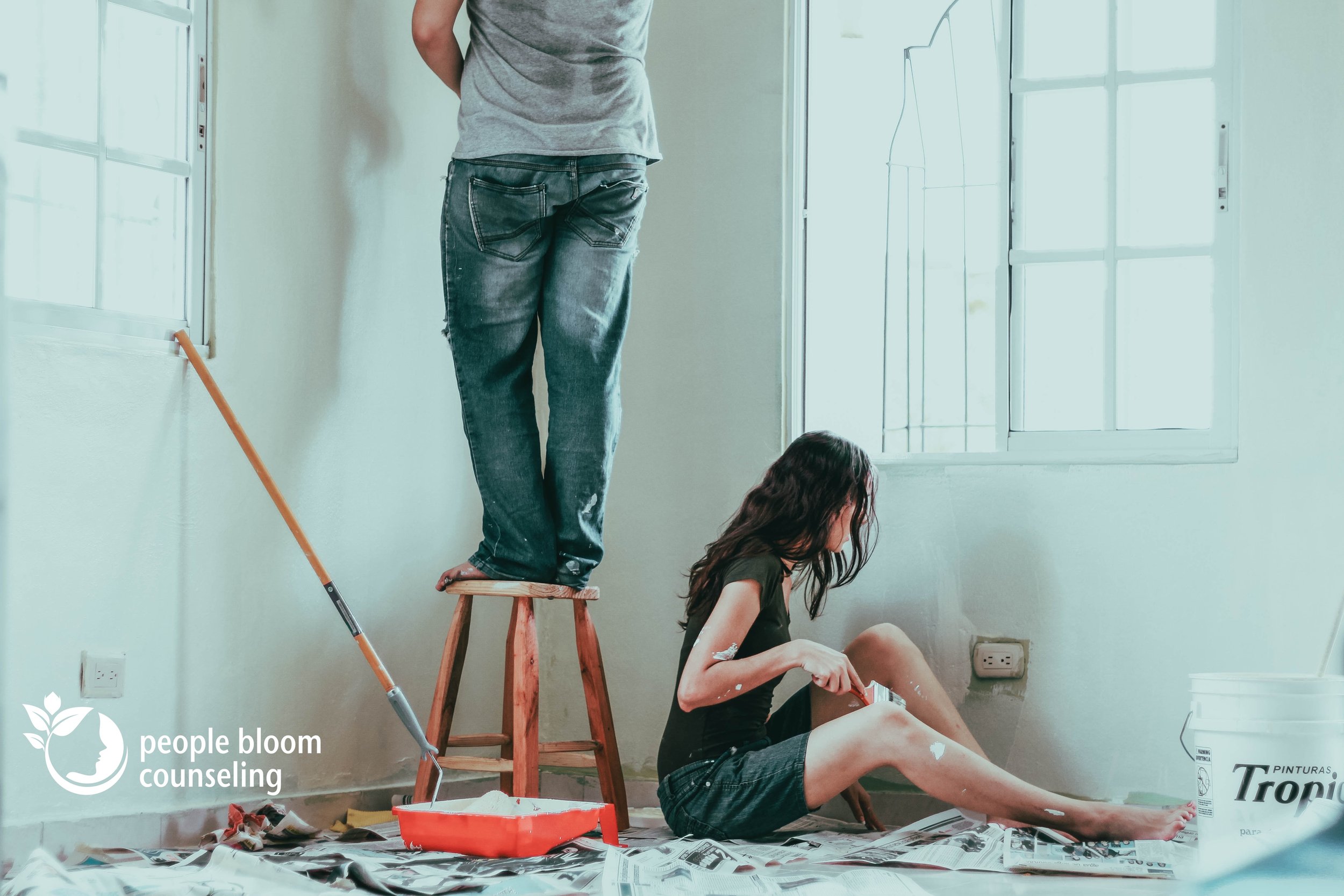
How to Renovate while Staying Sane and Without Killing your Partner

The pandemic has changed the way we view our homes. It’s a safe haven, a place where we live and work, and open up to host others. Many people engaged in DIY projects while spending an extended amount of time at home. Home Depot parking lots were full, even when other places were sparse. While it would be lovely if my partner and I were more handy, we once spent two and a half days and four trips to Home Depot just to change out an existing hood range. We also used three different drill bits and spent almost two hours putting up a pre-made blind. 

I’m not exaggerating. 

We have our strengths, but DIY projects that involve more than putting up a towel bar are not one of them. Thus, rather than spending many months half-assing DIY projects that we’d ultimately need to call contractors to come and fix, we knew we had to hire out. 

It can be really hard to write about a stressful experience when you’re still in the middle of it. That’s what happened when my partner and I spent eight weeks renovating this past fall, and I can only recount the experience a couple of months later. While we love our new home, and we packed, moved and set up without a hitch, the renovation was a different story. The stress level was a close second to other stressful events we’ve experienced apart or together.

We survived it without going bat-sh*t crazy or killing each other, but it was a long eight weeks, with many of the designs and decisions made prior to. Not-surprisingly, 12 percent of couples consider divorce while going through renovation. Part of this can be attributed to couples looking to a major life change to help save their already struggling relationship, but I can see why a home improvement project can put a strain on even a relatively good relationship.

With some lived experience under my belt, here are a few tips on how to renovate while staying sane, plus more tips for your relationship. 

Expect people to make mistakes

You don’t need to wait for the other shoe to drop, but expect that things won’t go as planned. The measurements were off, even though two contractors measured the space at two different times. Forty-six percent of the tiles arrived broken. The tiles installed in the inner kitchen corners were off-centered. Like, really off-centered. The contractor didn’t use the matching items we purchased and did their own thing. While some of these can be fixed, others are permanent. Initially frustrated, I’ve needed to learn the imperfection of it all as people tried their best to make our dreams come true.

This naturally leads me to the next point. 

Expect that you’ll also have regrets

Contractors are not the only ones who make mistakes; so can you. We thought we’d like ball catch closet doors, but now we understand why they were bifolds to begin with. I thought the tub would be too big but now it’s too small. I didn’t see how the countertop needed to be cut to accommodate not just the sink, but the matching cutting board. All this to say, we didn’t have experience to foresee these happenings but now we do. 

And that’s okay. 

Renovations always take longer

It helped that we were able to start on the demo a couple of weeks earlier than expected, but we couldn’t have accounted for the tub never arriving, the forgotten lazy Susan, or the shower door guys returning for the third time. We came right up against an out-of-town trip, so don’t do what we did! Give yourself at least a two week buffer. Try to not schedule any trips or guests immediately after the (new) planned end date. 

Enjoy your new space.

You will go over your budget

The costs of materials have gone up exponentially and contractual labor is in high demand. Renovations are just expensive. Despite your best intentions, you will go over your budget. In order to add a new sink, new pipes need to be rerouted. The kitchen will look more open if we also cut into this wall. Extra insulation was needed given what’s behind the wall. As our contractors billed by the hour, extra time and materials really added up. We made sure we saved a ballpark figure before we took the plunge, but even that was exceeded, thankfully not by too much. 

Couples often experience a renovation together, so the above tips will affect you both. But specific to your relationship, here are a few more tips:

Know your differences

It helps to know your differences going into a big renovation project. My partner cares that things function well; I care that things look good. He can imagine how something will look; I need a sketch or a picture to know what we’re dealing with. He wants to make sure there’s room to move around; I want spaces optimized. (Except for the shower niches, I wanted bigger ones or more than one, but that didn’t happen.) 

So, at the end of the day, when things don’t match or tiles don’t line up, but they’re still functional, guess who was more affected? 

It’s not a right or wrong, but it helps to know that we don’t experience the same situation the same way, nor do we have to. But we can still honor each other’s differences and how things show up for us differently. 

Let the other person lead in areas they care more about

When something bothers you, it means you care about that area more. Listen to that voice, give it air time, and ask to lead in that area. It helped that I narrowed down the design ideas and we made choices from within those limits. After all, I’m the person who cared that things looked pretty. My partner cared more about how things worked, so he took half a day to follow the electrician around so he can better understand how things were wired. That would’ve put me to sleep. 

I’m glad we complement each other in these ways. And even then, we were in constant communication. This brings me to my last point. 

Keep communicating, with contractors and with each other

For all the reasons mentioned, things will show up differently for you and your partner. I was more bothered by the aesthetics, so my poor partner heard about it more often than he’d like. And we had needed to learn that just because I’m airing my grievances to him, does not mean he needed to fix it. I only wanted him to hear me out, even if he didn’t agree. It was still up to me to communicate directly to the contractors what needs to be fixed, and to be present for the work. 

Some people really enjoy the renovation process. For us, we learned what not to do, some things about ourselves and each other, but mostly we are happy that it’s finally over. 

What about you?

Life transitions like a renovation can be very stressful. It can make the most adaptive person lose their sh*t. It can also put a strain on your relationship. We have therapists who can help you weather through these stressful situations. We want to help you grow through these life challenges, and for your relationship to come out stronger on the other side. 

Let us help! 


Ada Pang is the proud owner of People Bloom Counseling, a Redmond psychotherapy practice. She helps unhappy couples find safety and connection in their relationship. She also helps cancer thrivers and their caregivers integrate cancer into their life stories. Of the few DIY projects she and her partner did together, she has learned that there’s nothing awe-inspiring about switching out can lights. It was best to keep her mouth closed.

Tips from a Therapist: How to Be a Better Friend and Listener 

A couple of months ago, I went out for lunch with some of my college friends. We caught a glimpse of the early summer weather on a Redmond patio. We don’t see each other often, but when we do, it’s as if time never passed. We teased and caught up with each other. There was a certain ease that long-time friends bring. 

I was sharing one of my recent relationship struggles, when my friends nodded and gave me their undivided attention. One of them asked me a question, which prompted me to keep going. After all, I had more to say on this matter. I had barely taken a few minutes of airtime when, during a short pause, another of our friends began telling their story. Now I know it was their way of relating to what I had to say, but it was no longer about my experience. It became theirs and it never came back to me. 

This left me feeling like I was dropped. 

As a therapist, I know these moments happen all the time. There were quite a few of us. It was noisy outside. It’s not like we had a talking stick to pass around. But having been through these experiences, I know there are ways we can share space while feeling heard. 

Here are some tips to consider the next time you’re with your friends: 

  1. Hear them out

    A few minutes can feel like a long time but it really isn’t. They’re formulating their thoughts to put things in a nutshell. There are natural pauses for them to catch their breath. When was the last time you got undivided attention for a long stretch of time that isn’t in a therapist’s office or sitting around a Healing Circle? Here, you’re offering something therapeutic to your friend by letting them have the floor. If they have more to say, it means they’re not done. Let them go for a bit longer. Another few minutes of airtime can make the difference between feeling heard and feeling dropped. 

  2. Validate what they’re going through

    This is an age-old method for helping someone feel heard and understood. This is not about you being totally on board with what they have to say, thinking that you would’ve felt the same or made the same choice if the tables were turned. Rather, this is about you putting yourself in their shoes and walking around in them. You, in their shoes. You, for a moment, sense their struggle and see why it could be difficult for them, even if it wouldn’t be difficult for you. Saying things like, “That sounds hard!” or “Yep, that would suck!” can go a long way. That’s because for a moment, you allowed yourself to be them. 

  3. Hold off on your own story

    You likely have a story you can draw upon. Much like the #MeToo movement, it helps to know that you’re not alone when you hear other people’s stories and can share yours. However, just wait a few more minutes. If your story is also top of mind for you, you’ll have your turn. Don’t cut in when someone is still in the thick of their story. Assuming you’re surrounded by friends who have a deep respect for each other, your friends will make space for you. 

That day, I just needed a few more minutes to share the impact this struggle had on me and then I would have been ready to move on. I wasn’t looking for someone to problem-solve or even tell me they had a similar struggle. I only wanted to be heard.

You might ask, “Well, why didn’t you bring the conversation back to you”? By then, the topic swiftly moved on to dynamics between two people, which evolved into pets, kids and travel. The wind had been knocked out of my sails and I knew conversation would flow better if we just kept going. 

Hearing you out

When clients have friends and family who hear them out, that makes our job as therapists easier. I’m often grateful when clients talk about their good friends and how supported they feel. Of course, your friends can’t be your therapist and that’s where we come in. We can hear you out, make it about you, validate what you’re going through, and only share something from our lives if it can help you. And ultimately, we want to help you towards your goals, however that might further your life. 

If you need undivided attention, 55-min at a time, we’ll be here. 


Ada Pang is the proud owner of People Bloom Counseling, a Redmond psychotherapy practice. She helps unhappy couples find safety and connection in their relationship. She also helps cancer thrivers and their caregivers integrate cancer into their life stories. She’s grateful for her friends and despite them missing each other at times, they’re there to support and care for each other. She hopes that even in moments of disconnection, you can find your way back to your people too.

Tips for your Relationship while Setting Up your New Home

No matter how long you’ve been with your partner new situations come up, and when they do you learn something about yourself, something about them. As mentioned, my partner and I recently bought a house and moved. It hasn’t always been easy, but it helps to be working together rather than against each other. 

Having a new space comes with decisions about setting up your home. What kind of decor and furnishings do you want and where? What style are you going for? Do you want a security system and if so, which company do you go with? While this is still a work in progress for us, we’ve figured out a few tips along the way. 

Decisions you make on your own 

Do you ask your partner about most items you want to purchase or is it a surprise when the delivery comes? Do you set things up on your own or consult the other first? For us, it depends on whose “department” it is, how big the item is, and how much the item is. My partner likes to tinker with tech and he’s much better at understanding the mechanics of how something works. Thus, he can be in charge of replacing light switches and setting up the wifi and sound system. I need to know very little about what he’s doing in those departments, knowing that he reads reviews and chooses a middle-of-the-road product for us. 

I’m much better at organizing and balancing function with aesthetics. My partner doesn’t care where I put most things, provided I can help locate them when needed. It makes sense I’d be on the one scouring OfferUp looking for used furniture with drawers to hide our shit.

There are some decisions you and your partner can each make on your own given your interests and skill sets.

Decisions you make together 

I once had a friend who decided he and his partner wanted a baby grand piano and while she was out of town, he bought it as a “surprise” for her. Plopped in the middle of their family room, it took up more space than expected. Needless to say, it would’ve helped if they had made the purchase together. 

When it’s an item for personal use that’s larger than a certain size, my partner and I talk about it. That includes a piano keyboard, an exercise ball, and an under desk treadmill. We also need to agree on bigger items that will be in the common area, be it a couch, a bookshelf, or our dining set. When it’s a more expensive purchase, that deserves discussion as well. 

Lastly, where there’s an overlapping “department” issue, decisions should be made jointly. An example being my partner put up an alarm sensor, which was awkwardly placed in the corner of the room. The alarm system is his department, but things looking good is mine. We ended up taking the sensor off, chipping paint, and repositioning it. One of us was more upset about the chipped paint. We’ve since decided that if it’s something permanent that involves drilled holes or strong adhesive, I need to be roped in. 

Knowing what’s important to the other matters, which brings me to my last point. 

Being okay with differences 

Because my partner and I are different, it helps to be accepting of the other as their own person with their abilities, liabilities and preferences. While my partner is spatially strong and able to visualize how something looks, I’m challenged in that area. This led to us having to move and re-move our couch and rug like six times for me to see how putting those pieces at an angle does not work. While my partner would jokingly say, “I told you so!”, I wasn’t able to visualize it until I actually experienced it. 

Another example is how we have mismatched bar stools in our kitchen because he didn’t want to get rid of the old ones while I’ve gone on to prefer a different style. We plan to just leave it as it is; it is after all our home. 

Going through major transitions together 

Be it moving to a new state, a new home, or starting a new job, life is full of transitions. We have counselors here who are ready to help you tackle these changes with greater ease. 


Ada Pang is the proud owner of People Bloom Counseling, a Redmond psychotherapy practice. She helps unhappy couples find safety and connection in their relationship. She also helps cancer thrivers and their caregivers integrate cancer into their life stories. In the spring, she cares about weeding and making the garden look nice, while her partner is into setting up the sprinkler system. There’s probably more to lawn care than those things, but she has decided that’s a good start for newbies.

Tips for your Relationship while Packing and Moving

Having recently moved, packing and unpacking have become top of mind. My partner has five times the number of books I do, and all the items in the kitchen are my doing. There was random shit in every section of the house; things we’d forgotten we had or quite frankly, don’t remember when and how we might have acquired them. After all the hustle and bustle, here are a few tips for how to stay partnered while packing and moving. 

Leverage your strengths and different “departments”

While one of you might be better at organizing, you can’t do it all. If it’s an area of the house that one of you is more familiar with, then let that person do the packing and unpacking. My mom often says, “Oh, that’s your dad’s department…” and I borrow that phrase from time-to-time. I have no business in trying to decide which books my husband should keep or how to pack stuff for the RV, nor would it be helpful for my husband to determine where things should go in the kitchen as the sous chef. 

It can still be a good idea to give recommendations like, “I think we should get a tub to organize our RV stuff in the garage,” or my husband picked out the spice drawer in our kitchen while I organized everything else. Other than that, it makes sense for one of you to lead a “department” you’re more well versed in and for the other to be okay with the decision made. You can still adjust and shift things when you’re settled in, but during crunch-time, focus on what you’re good at and the areas of the house you’re most familiar with and let your partner do the same. 

Know that at least one of you is a pack rat

In the early days of the pandemic, I Marie Kondo’ed a lot of my wardrobe, paperwork and memorabilia. After all, there were clothes I kept that I haven’t worn in years, worksheets that I can easily find online and cards from second grade I’d never look at again. My husband didn’t share my enthusiasm for decluttering. He said the only thing he wanted to Marie Kondo was the Marie Kondo method itself! 

And so, when it came time to pack, I had a much easier time. After a couple more years in the pandemic though, the things I found important to keep changed yet again. Now cards from twenty years ago also made it into the shred pile. My husband with his more varied interests and hobbies had more sorting to do. While I had, on occasion, made comments like, “Are you going to keep that?” I’ve tried very hard to focus on my pile and my “department”. 

It’s a-okay to have a pack rat amongst you. That’s most couples I know. While I would’ve wanted my husband to throw or give away more from his collection, he did the best he could given the stress and that was all I could ask for. 

Go at your own pace and work at different times

Packing and moving is stressful and couples don’t always have the same capacity at the same time. There were moments where I was knee deep in decluttering and my husband was on the couch on his phone. Contrary, when he was running up and down the stairs like a chicken with his head cut off, I was sitting on the steps on a call with a friend. We each worked to our capacity on that given day and had to take a break. While it’s easy to think that your partner shouldn’t need to take a break with his buddy when you haven’t even found the time to run to the bathroom, first of all, go use the bathroom. Second of all, if you’re both working hard towards a common goal - and some days you have more in you than other days and vice versa - then this is you, packing and moving together

What about you?

If you’re packing and moving or going through other life transitions, we get it! We have clinicians for whom this is a well-traveled path. We’d love to help you and/or your partner adjust to this next phase of life. 


Ada Pang is the proud owner of People Bloom Counseling, a Redmond psychotherapy practice. She helps unhappy couples find safety and connection in their relationship. She also helps cancer thrivers and their caregivers integrate cancer into their life stories. She knew they weren’t planning to move when she found two Costco jugs of laundry detergent while packing. She took a picture to capture the moment. Sometimes it’s hard to take life too seriously. 

Tips for your Relationship while Buying a House Together

My husband and I recently bought a house! It hasn’t always been a smooth process and there was a lot of back and forth. But, now that this is almost behind us, I have a few thoughts about how the home buying process can be a relationship builder rather than a relationship breaker. 

Consider each other’s preferences 

I have yet to meet a couple where things mattered equally to them. One partner runs hot and wants to make sure the primary bedroom isn’t west facing. The other partner regulates temperature just fine and wouldn’t care either way. One partner likes a large primary bathroom; the other ample storage. For one, “I want an open floor plan!” and the other, “A sink in the laundry room!” As you consider your next home as a couple, take on each other’s preferences and advocate for them. “Look, you’d like this floorplan because the closet is separate from the primary bathroom!” “This can be your office on the main floor!”

I’d encourage you to be as excited about your partner’s preferences as your own. Put on their shoes and walk around in them. After all, there’s no better person to share space with than someone who considers and vouches for you, and you for them.  

Decide as individuals, separate from each other 

The home buying process is an emotional one. I recently witnessed a couple where one partner pushed to sell their home while the other dragged their feet. It created a lot of turmoil. Things were smoothed over when they found their next home, but had it not been for that, the rift between them would’ve continued. 

As you make a home purchase decision as a couple, talk through the process, but also take time separate from your partner to think about the purchase. It’s easy for one partner who feels more strongly about the house to lead the decision against the other’s wishes, which can lead to regret and resentment. How do you individually feel about the house? Are you, as an individual, ready to make this decision? Is now a good time for you?

If one partner in the relationship is putting on the brakes, do not proceed. There may be other decisions where you let each other lead depending on your skill sets. However, unless one partner is genuinely indifferent, or both partners are on board, keep looking.

I find it comical that my husband and I took turns being ready and not ready to put down an offer and did not proceed until we were both ready. While it can be hard to afford the luxury of waiting during a hot housing market, your future home is your sanctuary. It’s important to find something that’s fitting for both of you. 

Know your communication styles 

It’s common in a relationship to find one partner who is a verbal processor and the other who, for a lack of a better word, isn’t. While you’re playing the devil’s advocate, your partner hears that you don’t like the house and you all shouldn’t consider it. Or, when you’re just getting things off your chest, your partner is losing sleep planning and plotting to make these ideas a reality for you.

If this applies to your relationship, let your partner know that you’re just needing to talk this through. It doesn’t mean the house is off the table, or that they need to make something happen for you. Rather, when you feel seen and heard, that was the solution and you’re now ready to keep going. 

Remind each other to be realistic about your home purchase

Many people want to find the perfect home. Just as it’s hard to find a perfect anything, a perfect home doesn’t exist. Unless you build a house from the ground up, and even then things can go wrong, it’s best to be happy with a good enough house. If a house checks off 80% of what you and your partner are looking for, that’s a pretty darn good house! If you find your hearts keep coming back to this house as you tour other ones, it might be saying something to you... 

Our agent told us there are times when at least one partner in the relationship was so upset over something small, an example being the curtains were not staying, that they almost didn’t close on the house! The home buying experience is stressful enough; let’s work through these impasses so it can be a win-win situation for everyone. 

Stay tuned for other musings about how to stay partnered while renovating! As always, if you need help navigating your couple relationship through home buying, moving, parenting, or any other transition, we’re here for you. 


Ada Pang is the proud owner of People Bloom Counseling, a Redmond psychotherapy practice. She helps unhappy couples find safety and connection in their relationship. She also helps cancer thrivers and their caregivers integrate cancer into their life stories. Through this home buying process, she has gotten to know her husband in a deeper way, and him her. She hopes you can find your way through various transitions with your partner too.

Three Reasons Why Traditional Talk Therapy Still Matters in the Age of TalkSpace and BetterHelp, Plus a Bonus

In the age of TalkSpace, BetterHelp, and Cerebral, traditional talk therapy is getting a bad rap. While these app-based services helped to create greater accessibility to mental health services, the pandemic has moved most mental health services online. Masked in-person visits provide social connection for those who want to leave the house, while the ease of commuting only 20 steps to your appointment is also an option. As a therapist trained in providing mid and long-term therapy, there are several reasons why I believe traditional talk therapy still matters. 

Longevity of relationship 

There are some clients I’ve known through job changes, a miscarriage and pregnancy, heartbreaks and new relationships. I’ve seen them through milestones and walked with them through peaks and valleys. 

There’s something sacred about being known and seen, when the relationship goes deep and is built through seasons of life and living. While texts and emails can be ways to connect, they are no quick fixes or replacement for a consistent human connection. This doesn’t mean you need to stay in therapy for a long time; clients come and go and come back, now with kids and new problems to tackle. The difference is they don’t have to start from scratch. 

Know how you tick

It takes time to get to know someone and be known. Some people are slow to warm up so rapport and progress can’t be rushed. Overtime, I get to know how clients respond across situations and we notice patterns. It's common for me to say in sessions, “We know this about you…” or for clients to say, “You know me so well I can say this to you…”

This deep knowing doesn’t come through brief interactions over text or voice note. This deep knowing allows for us to pivot when a modality doesn’t work, or for us to learn how to best help you. Are these conversations with your friends too hard? Let’s slice it thinner. I see that you like going on a monologue. We can take turns and I’ll reflect and make recommendations. You tend to make changes from something we talked about months ago? Now is a good time too.

Let’s do you.

Witness to your process and progress 

As both a recipient and provider of therapy, I’ve seen how progress takes time. The potential for change is understood in the history and context of the person being seen, not quick remedies to be doled out. And there’s something very healing about someone noticing those changes, witnessing that growth and reminding you how far you’ve come. “Do you remember how that used to bother you so much and now it’s just a shrug?” “You’re really noticing what’s showing up for you and pausing before reacting! Are you seeing that too?” “You’re opening up to your partner in ways you haven’t before. Wow! That’s huge!”

Who is there to see you when you’re struggling and when you’re making strides? A therapist who knows you and has been with you can be that person for you. 

A bonus: Safe parameters around the work

Most people think that traditional talk therapy requires weekly sessions, but it really depends on what you need, what your schedule allows, and what’s within your budget. Regardless of the cadence, there’s space in between sessions to process the work, without a need to constantly engage on that topic. The fact that you’ve paid into an online counseling platform like TalkSpace means you’d want to make the most out of it. I have the most beef about the messaging function which touts 24/7 accessibility to your therapist without creating safe parameters for the work. 

It is good and healthy to take a break from your problem and go on to live your life. You have other things going for you. Where you notice you’re struggling, come back to your next session and talk about it. Use the therapy space to contain your problem and know that your therapist will hold it for you until you return. There’s safety in knowing this important work has boundaries; it’s there to protect you and your therapist from burnout.

Making traditional talk therapy work 

While traditional talk therapy can feel more structured, be more cost prohibitive, and doesn’t have a flashy platform, there are ways around it. Structure is not always a bad thing and your therapist might be able to provide flexibility for shorter or less frequent sessions. Unlike online counseling platforms, talk therapy is covered or can be reimbursed by your health insurance plan. Many therapists also have a certain number of reduced fee spots reserved for under-resourced clients. 

Lastly, therapists came into this work to help people, and tech platforms that are built for therapists are not the most user-friendly. So, when you see therapy practices cobbling multiple systems together to provide a service to you or there are glitches in the systems they use, please know they’re doing the best they can with the resources they have. 

There’s help for you

Regardless of how you go about nurturing your mental health, there’s help for you. We have a team of licensed mental health professionals who will take the time to get to know you and meet you in real time. We’ll make recommendations tailored to you and your needs and see you through your process and your progress. 


Ada Pang is the proud owner of People Bloom Counseling, a Redmond psychotherapy practice. She helps unhappy couples find safety and connection in their relationship. She also helps cancer thrivers and their caregivers integrate cancer into their life stories. She’s grateful to her therapist who witnessed her ugly tears around family issues in grad school and saw her gush over the man she ended up marrying, to the eventual meeting of this man for couples counseling. There’s comfort in being known and accepted through time.